Showing posts with label inspection. Show all posts

Saturday, July 15, 2017

Out of the frying pan...

...And into the heat of an Alabama summer.

Did a check on (almost) all the hives today.  In the outyard, the hive that I have been concerned about has finally started getting rev'ed up.  The pictured frame is like like this front and back.  The pattern isn't going to win any awards, but I think it will be enough to get them through the winter.  The queen has gained some size and has started on a second frame of eggs.  Whew.  I guess the bees really did know what was best.  

  
The new queen has finally gotten busy.


The second hive in the outyard has a virgin queen, pictured below.  They also have an unhatched queen cell.  I left it in and am questioning that decision, but the virgin walked right by it and didn't attempt to cull it.


Another (blurry) queen pic.


In the backyard, the orange hive has filled and capped 7 frames in the super that they were left.  It's very pretty, white capped honey.  I put the escape board down and will pull it tomorrow.  They looked like they were doing a pretty good job of filling the top box.  I didn't see any brood, but it's still a bit early for that.  

In the white hive, the bees were in a very foul mood.  When I opened them up, they poured out of the inner cover and all around me.  One of them found her way into my jacket and a few found a way through my jacket, so I had to put on a second jacket.  That's never a fun thing.  Thankfully, the beekeeping gods were shining down on me because the very first frame I pulled contained eggs, larvae, and capped brood.

The Auburn nuc looked good.  I thought I smelled slimed honey, but didn't see it or really very many SHBs for that matter.  Both sides had a strong population, so maybe I'm just being paranoid.  

The dark green nuc was a mixed bag.  The weaker half finally has a queen.  It's funny because I had to go down to the last frame in the bottom box to find any evidence of a queen.  When I did find it, I could have sworn that I saw multiple eggs in some of the cells.  I know that young queens sometimes release too many eggs at first.  I was seeing two, sometimes three, eggs in a several cells.  Just as I had convinced myself that I had a laying worker, I spotted the queen with her back end stuck down in a cell laying.  

The stronger half of the nuc has apparently either cast a swarm or decided to requeen for some other reason.  I'm thinking swarm because there were about 6 queen cells that were capped (or close to it).  They must have started building these things just after I closed it up last time because I've been keeping an eye out for signs of swarming.  This is the second time this year that I've had a hive swarm after the solstice with seemingly plenty of room left.  This half of the nuc had 3 frames of foundation that they hadn't even started to draw out.  In fact, I'm kind of concerned with the amount of comb that's not being drawn right now.  There is obviously something still coming in.  I've tried feeding twice in the outyard and both times the syrup has fermented before they used it.  So they definitely aren't going hungry.  But at the same time they aren't drawing foundation either.  This is happening in multiple hives, so I just don't know what to think.

I didn't get in the light green hive today due to a close call with heat exhaustion.  I didn't realize until it was too late that the temp had gotten up to about 94 degrees.  I tried to do too much and almost got sick.  Let that be a lesson to you boys and girls.  Drink lots of water and pace yourself.  Don't be like me.  

Saturday, July 8, 2017

C'est la vie

In the outyard, I'm finally starting to see some signs of life out of the hive in the old stand.  There is still only a little capped brood, but almost a full frame, front and back, of open brood.  I'm interested in seeing how much of that actually gets capped.  I'd been thinking that queen might have mated with a son or grandson, and that would explain why the poor laying pattern.  That hive also had tons and tons of bee bread, so they should be in good shape to raise brood if the queen is ramping up.  Overall, I'm feeling hopeful for this hive's survival.

Also in the outyard, the other hive seems to have cast a swarm.  There are a handful of queen cells and no eggs.  The youngest larva I saw was maybe 5 days old, so that is probably about the time they left.  Truth be told, I'm a little perplexed by this.  They had plenty of room to expand.  There are still at least 5 frames of undrawn foundation and plenty of room for the queen to lay.  The main flow is also over, though the frequent rains have extended this year's clover bloom some.  They were also just moved into this location two weeks ago and I would have thought that would have quashed the swarming urge.  The only thing I can think of is that this queen came from the same batch as the other queen that swarmed on me this year, though I know that swarm was totally my fault.  I feel really bad about that, because I do live in a city and I do try my best to keep my hives from casting swarms.  I don't want them moving into the neighbors' houses.

The light green hive is still working diligently to fill the top box for winter.  I went ahead and checked the bottom box to prevent any more late-season swarms, but didn't see any queen cups, so so far, so good.  I took a mite sample from the frames that still have brood in the top box.  I suspect that I will soon have to go all the way into the bottom box for broodnest samples.  I had to shake two frames today in order to get enough bees for the sample.  I ended up with 5 mites in the sample.  That's the same as it was last week.  Still not great, but at least it's not any higher than last week and it's (slightly) under the 6 mite threshold for this time of the year.

For a change of pace, I got to play with some chickens today.  Unfortunately, it's not at my house.  My city doesn't see the benefit in allowing backyard chickens.  We helped build a coop for some friends who were recently gifted some chickens from someone who was moving and couldn't take them with him.

Wednesday, July 5, 2017

Just a quick nuc update

Nothing like spending the Fourth of July in a hot bee suit checking on the girls.  Gotta love it!  I decided to take a peek in on the nucs yesterday.  I've decided that if I had it to do again (and for that matter might transition to n the future), I'd definitely concentrate on raising nucs rather than full sized colonies.  They take a little more attention, but inspections are so much nicer.

So, the older half of the dark green hive is chugging along.  They have a good bit of brood, but they also look like they are starting to turn the upper box into winter stores.  This is a good sign.  I believe that there is still forage available because the hives in the outyard that are being fed are not taking it nearly as quickly as I would have expected if we were in a true dearth.

The newer half of the dark green hive is starting to draw out the foundation that they had, so that's another decent sign that the summer dearth hasn't totally set in yet.  They are still very slooooowly raising brood.  But it seems that there is mutiny amongst the masses.  I found two queen cups in what would traditionally be considered a supercedure location.  I believe that these are being used or going to be used because I saw workers going in and out of them.  I couldn't see for sure whether there was an egg in it or not.  (On a side note, why does the sun have to go behind clouds just as I need a good bright light to see eggs?)  I've been debating what to do about this colony for a couple of weeks now.  The queen had gotten a slow start, but now doesn't seem to be ramping up at all.  She's also still quite a bit smaller than her sister queens.  The workers now seem to have caught on to this fact too and are attempting to raise a queen before winter.  I hope it works for them.  There are still drones in other hives, so I think that we still have a little time.  I called my local source for queens, but they are out for the year, so if this colony is going to make it then they are going to have to raise a queen.

Both sides of the Auburn nuc look fantastic.  One side is starting to fill up the top  box for winter while the other is still raising a lot of brood.  That side will make an excellent brood donor if I end up needing it.

Monday, June 26, 2017

It's funny how things work out sometimes.

I've been feeling a little bad about neglecting all the nucs lately, so I decided to take a peak at them after work.  It's a good thing that I did.

The older half of the dark green hive was completely full and probably were only a day or two from swarming.  I found one frame with a queen cup that looked longer than a normal cup.  I couldn't tell if there was anything in it yet, but there was a worker going in and out of it, so I would hazard a guess and say that there's something there.  There were also two frames with empty, dry queen cups.  I pulled the frame with the queen cell and replaced it with foundation.  I then moved it down the street to the hive in the outyard with the hinky queen.  Maybe they'll decide to replace her.  I thought I saw a few eggs today, but still nothing record breaking.

The newer half of the green hive has some nice looking activity.  I saw the queen, but I didn't see any eggs.  The queen came from the Auburn nuc half that probably swarmed on June 1st, so it's likely that she's not quite old enough to be laying yet, especially if her mating flight was delayed by rain.  She has the elongated thorax of a mated queen, but she's smaller than the other queen in the dark green hive.

The newer half of the Auburn nuc, the half that didn't swarm, is also booming.  Lots of brood, lots of honey.  Enough brood that I was able to take a frame from them as a donation to the hinky hive down the street.  But no swarm cells.  It seems that this colony got the memo about it being after the solstice.  

The half of the Auburn hive that did swarm is doing alright.  There are eggs and very young open brood.  The queen made it back and is laying in what seems to be a very nice pattern so far.

I also checked the white hive in the backyard.  They look good.  Finally.  The hive in the outyard that is on it's second queen got a frame of emerging brood and a frame with young larvae.  I'm hoping that this will give them a boost.  Normally, I would think twice about throwing that many resources at a hive that has been questionable at worst.  But with the resource hives sometimes you need to pull frames to keep them from getting too full.

Sunday, June 25, 2017

It's been a long day.

I never want to have to clean a slimed out hive again.  I'm like 80% sure that if there's a next time then I'll just burn the frames and be done with it.  That sucked.  The smell.  The slime.  The gross little larvae crawling around.  No thank you.  I still need to treat the ground with a drench, but I seem to have misplaced the bottle of Gardstar that I had.  And I almost passed out from the heat.

What I ended up doing was pulling the entire slimed out hive off the stand and replacing it with the queen and five frames of brood from the orange hive.  I left them in a single deep box for the time being.  Just like starting a nuc, only a little later in the season than I'd prefer.  I'm hoping that this will do two things.  First, I hope that this will be a strong enough colony in a small enough space to ward off the small hive beetles.  Second, I'm hoping that cutting down the size of the orange hive will make them a little less defensive once they've (hopefully) become queenright.  They definitely remembered me this morning.  Like 10 of them met me at the gate.  I guess that means that my Sunday morning coffee time next to the hives is over for the year.  But the joke's on them because I wore double gloves, jacket, and pants today so none of them were able to get through.  The heat was a bitch though.

I reduced the other hive in the outyard down to a single deep too.  They have a queen, but I didn't see a whole lot in the way of open brood.  Maybe between the dark comb and the bad lighting there's something there that I'm not seeing, but it's not looking good.  If I don't see an improvement next week then I'll pinch the queen and give them a frame of eggs from somewhere, but that will be the last resources I throw at them this year.  This is the second queen that has returned to that hive to only to seemingly quit laying after a week or two.  Add that to the two virgins that never made it back to other hives and it's been a very bad year for queens here.

I ended up doing the OAV treatment on the light green hive first thing this morning.  I'll be taking samples each week for awhile to see what my mite numbers look like after isolation plus OAV.  I really need to peek into the nucs and the white hive in the backyard, but I just didn't have it in me today.  I'll probably regret that.

Saturday, June 24, 2017

0/10. Would not recommend.

Well, last week I said that things could be worse.  Apparently, the universe took that as a challenge.  Today was one of those days where I ask myself "Why did I think that beekeeping was a good idea again?"

I woke up excited because today was going to be honey-spinning day.  The weather wasn't cooperating, so I suited up in full gear and headed out between rainstorms.  I started at the outyard.  I only had supers on the hive sitting in the new stand.  I open it up to an odd smell.  Small hive beetles had slimed every frame in my super!  That's odd.  That hive had been doing really well prior to my putting supers on it.  It appears that they had done so well that they decided to swarm.  Four weeks ago if I had to guess.  And the virgin never made it back (that's par for the course this year).  This is totally my fault.  I assumed that because they were the queenless half of the split from early April and that they had plenty of room in the supers that their swarm impulse would be quashed.  I was wrong.

Right now, the plan is to remove all of the slimed frames and clean them out.  I'll probably just shake the bees out.  Then I'll move one of the nucs from the backyard to that place and feed them until Goldenrod starts.  I'll treat the area around both of the outyard hives with Gardstar to keep the problem from spreading to the other hive because it's got a queen, but she's not kicking ass.

That brings us to the orange hive in the backyard.  They were not happy to see me.  They were even less happy with me when I started pulling frames of honey.  I ended up having to add a second bee jacket on top of the one I was wearing because they managed to get through the first one.  they landed about a dozen stings, including two on my ear from some determined girls that managed to make it inside my veil.  It wasn't pretty.  They surprised me by filling out one full super of honey (less the two frames that they decided to turn into brood comb) and making a good effort on a second one.  I got 12 frames of honey from them and gave them 6 frames back, on top of a queen excluder, to finish curing.  Next time they will get a bee escape.


See all the stingers?  I probably took a couple of hundred stings with about a dozen getting through.


More stingers
Their population is massive.  So much so that I'm afraid of a swarm.  We're in a dearth, so I hope that will prevent it until I can do something about it.  I think that I'll pull them into a nuc to replace the one that's going to replace the slimed hive in the outyard.  I had planned on isolating their queen for mite control today, but that's on hold for now.  I still have to treat the light green hive with OAV tonight.  I need to get my jackets in the wash before I do that.

It's still draining, but it looks like I'm going to get between
3.5 and 4 gallons.  Not bad for one hive.  
But then it was time to extract.  I got to use my new toy.  It took five or six frames to really get the hang of cutting off the cappings.  I can really see how using a nine frame setup with the correct spacing would make life easier when it comes to decapping frames for extracting.  I think we'll give that a try next year.

Sunday, June 18, 2017

Happy Father's Day

Today's theme in the apiary is "Well, that could have been worse."


I think I need to break out the weedeater.
Today's weather has been hit or miss.  I took advantage of a small break in the clouds to get a little bee work in, but the bees were not in a very good mood.  First on the agenda was to release the queen that's been in queen jail for the last 18 days.  They'll get an OAV treatment on Saturday night and then I'll take mite samples for the next couple of weeks to get an idea of how effective the queen jail technique really is.  The queen release went a lot better this time than the last.  Slightly twisting the cage before pulling it out seems to be the right technique.  The queen walked out and seemed to immediately start looking for cells to lay in.  I then said the beekeeper's queen prayer and closed up the hive.  You know the one.  "Please don't let me crush the queen closing the hive up."  

Anecdotally, I had to cut out a queen cell found in the middle of the frame where the queen jail was located.  I believe that traditional wisdom holds that an egg only exists where the queen lays it.  But recently, there's been rumblings in certain corners of the bee world that bees can actually move eggs around if needed.  I'm beginning to believe that there may be something to that theory.


This was my husband's "artsy fartsy" shot
While I was out there, I went ahead and checked on the half of the Auburn hive that was split off on 5/21.  They weren't too happy to see me (and let me know LOUDLY) when I opened the hive, so I thought that maybe they hadn't been successful in requeening.  I never did find the queen, but I did find some pretty compelling evidence that she is there.  There's not much capped brood, but there is quite a bit of uncapped brood and eggs, so she's been laying for a couple of days.  I think I'll try to get an OAV treatment in this evening since they are in a good configuration for it.  Again, said the queen prayer and closed up the hive.  

I also poked around the dark green hive.  The older half is doing well and has a pretty good brood pattern going on.  The newer half is doing better than expected.  The younger queen cell was torn open from the side so it looks like she was dispatched by a rival queen.  I think I saw that rival queen walking around a frame in the first box.  She was kind of walking around poking her back end into cells, but I'm not sure that she was actually laying eggs.  I didn't see any, but the light wasn't great for egg spotting.  She was born from a queen cell that came out of a nuc that I believe swarmed on June the first.  It's not outside the realm of bee math that she could be mated and laying already.  I think I've got time to wait on the last bit of capped brood to emerge before an OAV treatment.  I think that I'll do it Saturday when I do the light green hive.  I did crush what appeared to be a small hive beetle larva that was between the inner cover and the top box.  I didn't see anything inside the box itself and really didn't see any adults in the hive either, so that's something I'll have to keep an eye on.

In the outyard, the hive sitting on the old stand has a queen and she's laying.  I even saw her.  The brood pattern isn't fantastic.  It's kind of spotty so far and there's more drone brood than I'd like to see, but the bees don't seem to be trying to replace her so maybe they know something that I don't.  I did notice a drone walking around with DWV.  That kind of surprised me.  They've had two separate brood breaks this season, so their mite numbers should be fairly low in theory.  This is something that I'll have to consider soon.  I like to have the last mite treatments done by August 15th.  It also didn't look like they had even started taking the 1:1 syrup that I gave them on Monday, so I removed it.  I don't like leaving syrup on for too long because it will ferment.  I'll try again in a few days.  Some hives will only take supplemental feed if there is nothing going on naturally.  It looks like this might be one of those hives.  

Sunday, June 11, 2017

Long Live the Queen!

I poked around in the outyard hives this morning.  In the hive on the old stand, I was checking to see if the requeening attempt from 5/13 had worked.  On the frame where the queen cells had been, I found a queen cell that had been opened from the bottom as well as one that was in the process of being torn down by the workers.


The Royal Nursery


A few frames later, I caught sight of Her Majesty.  She's walking around and laying eggs.  I'm a bit concerned because the capped brood I'm seeing seems to be heavily weighted towards drones.  I'm hoping that is just a fluke and she did get well-mated.  If she didn't then it's really getting too late in the season and their population is too low to try to let them raise a new queen on their own.  I'll have to bring in a new queen.  Which it wouldn't be the most terrible thing in the world to expand the genetics of the yard a little.  


Yes, I need a new camera

The other hive is doing much better.  They were given a super of mostly uncapped nectar from last year and they are finishing it out.  I have six frames of beautiful, fully capped honey, two frames that are 1/2 to 2/3 capped, and two frames that were drawn out, but not filled (they were on the far end).  I moved the partially capped and empty frames to the center and moved the fully capped frames to the outside edges to encourage the bees to finish out those frames.  Hopefully that will work.  This hive has a second super of foundation and starter strips, but they have only barely started to draw it out.


Yum!

Sunday, June 4, 2017

Lessons Learned

Urban (or suburban in my case) beekeeping comes with it's own set of considerations.  A lot of non-beeks take a NIMBY stance on bees.  And some have good reason to.  Those of us who live in a city need to keep our neighbors in mind when it comes to our bees or we may find that the city will start passing laws against keeping bees (boy, do I know about that one).  I try to do my best to mitigate the hazards that come when bees and people live in close proximity.  I supply them with a close water source.  I position the hives so that there are obstacles that force bees to fly upward before they cross into the neighbor's yards.  I do my best to prevent swarms, though I daresay that is as much for my benefit as theirs.  On that front, I seem to have failed.

I opened up the Auburn hive to peek in on them.  On the half that held the original colony, I found two frames with queen cells.  One of them was sealed.  My brand-new, marked queen was also nowhere in sight.  Based on the age of the youngest brood I was able to find I'd say that they took off about three days ago.  It's totally my fault for not paying enough attention.  I'd been doubting my decision to leave the old queen in place and move the swarm cells during the last split.  I know now that I was right to question that decision.  I won't do that again.

I have been planning to pull a couple of frames of brood off of the orange hive to start a nuc after honey season ends.  I want to go into winter with 5 full colonies and 4 4-over-4 nucs.  If you're interested in my reasoning for this configuration I encourage you to check out some of Michael Palmer's talks regarding his sustainable apiary.  It's good stuff.  So, to make light of a bad situation, I split the two frames from the Auburn hive with queen cells between two nucs and gave them each half of the resources.  I'll have to boost their numbers with frames from other hives (probably the orange hive), but this will give me a bit of a head start.  They are going to require a lot of TLC though.

In other news around the beeyard, the light green hive still has their queen caged.  I did have to cut a few queen cells out of the hive, but not as many as I had expected.  The orange hive got another honey super.  I don't expect them to do much with it this year, but it'll give them something to keep them busy.  In the outyard, the hive on the new stand hasn't done much with their second super, but they are at least starting to draw it out.  The hive on the old stand got a second story to work on.  I suspect that they will need some supplemental feeding once the summer death sets in.

Sunday, May 28, 2017

Unofficial Start of Summer

Happy Memorial Day everyone.  While it's the unofficial start of summer for the rest of the country, for beekeepers in my neck of the woods it often signals the end of our spring flow.  I'm getting reports from areas both north and south of here that they aren't seeing much movement on their hive scales.  Locally, I'm still seeing a good bit of clover blooming and that makes up a large portion of our flow.  The clover isn't nearly as abundant as last year.  It's been a drier year than last; I hope this doesn't translate into another drought.  The spiderwort in the front yard is winding down, but the clover is still hanging on.  We have had a few rainy days lately, so maybe that will prompt a little resurgence in the clover and a last minute bump in production.  Something is blooming because I'm seeing a little bit of pollen coming in.  I'm kind of glad that I decided to order a new feeder instead of a new honey super to fill out my Mann Lake order.  Speaking of, I think that I put together the last of this years frames.  Have I mentioned that I hate wiring frames?


Waiting on the crosswires. 

I checked on the queen in the green nuc today.  I thought it would be a quick check, so I geared up all the way and didn't light up the smoker.  They weren't happy to see me, but weren't able to get through the suit of armor (jeans + Carhartt pants + jacket/veil).  This was the one that had dropped on the ground.  I was afraid that because she had been isolated for awhile and then out of the hive overnight that they would reject her.  I found her walking around, so she seems to have been accepted.  I noticed that almost all the capped brood had emerged, with the exception of a few very small patches of drone comb.  I think I will treat with oxalic acid on Wednesday evening.  Any eggs laid yesterday or today won't be capped yet and it will give the last bits of capped brood a little more time to emerge.  The hive itself has a LOT of nectar and capped honey and almost a full frame of pollen of all colors.  I tried to take a picture, but accidentally left my camera in the house.  I've gotta do better about that.

I believe that I have a mite problem in the light green hive.  I've seen some DWV in the hive and I'm still seeing a lot of crawling bees.  I think that the colonies that didn't get a broodbreak (orange, light green, Auburn nuc, and outyard new stand) will get treated with a series of OAV treatments.  Unfortunately, it is rare for our bees to go completely broodless here, so the series method is often used in summer to get healthy bees going into fall and winter.  I'm hoping to expand the isolated queen method to full sized hives eventually.  I just need to work out the correct timing so that the dip in population corresponds to the summer dearth.

Wednesday, May 24, 2017

That....Did not go as planned

The plan for today was to go in and uncage the queen in the green nuc.  For the last 18 days, she's been confined to a push in cage.  The idea was that confining her to a small section of comb would induce a period of broodlessness and make an OAV treatment more effective.  As you can see from the pictures, I didn't wait until the colony was completely broodless to release her.  The capped brood not under the cage is, at least, 18 days old.  Therefore, I expect that in 6 days it will all be emerged and that's when I'll treat.  Sounds easy, right?

Queen Jail


First of all, when I opened the hive up, the girls were in a really, really bad mood.  The weather was changing and rain was coming.  Because I thought this was going to be a quick operation, I only put on my jacket and veil.  I also only put about 30 minutes worth of smoker fuel in.  I would come to regret both of these actions.

So, as soon as I opened the hive, they let me know that they weren't happy to see me.  Of course, you'd be unhappy too if someone pulled the roof off your house and started moving the furniture around.  Almost immediately I took a sting through my jeans.  Now I'm regretting not putting on my Carharts.

I pull the frame with the queen on it and she's still in there.  There's a queen cell hanging out of the side of the cage.  It looks like she was able to get an egg close enough to the workers for them to build a new cell.  I knock that off and try to take the cage off the frame.  Uh-oh.  It's stuck.  No amount of wiggling and twisting will get it to come free.  I end up tearing a whole chunk of comb out the size of the cage.  Now I've got the cage, with the queen still in it.  I carefully peel a corner back to let her out.  And about that time I realize that a bee has made it into my jeans.  Crap.  There's sting number two.  I set the cage down over the hive box and scrape the stinger out of my leg.  Now I'm regretting not putting on my boots.

A Closer Look
I go back to the cage and she's out.  I quickly look over the frames that the cage was sitting on, but I don't see her.  The girls are getting more agitated so I close it up and call it a day for them.  They were a little honeybound, so I took one frame of nectar and gave them a frame of drawn comb.  That will at least give the queen somewhere to lay for the next week or so, assuming she's in there.  I looked around and didn't see any clumps of bees on the ground that would indicate that there's a queen there.  I'll check them again in a few days to see if there's any eggs.  If there is then I'll go ahead and do the OAV as planned.  If not, the Auburn nuc had queen cups on three different frames so I might be able to take one of those.

So, what's the verdict on this method of mite control?  I still believe it has possibilities.  The cage did keep the queen contained for the requisite number of days.  Did having her in there keep some sort of order in the hive?  Yes and no.  They did create queen cells so caging her in that small of a cage didn't produce enough queen pheromones to suppress the emergency response.  But, up until today they had been fairly docile and didn't really "act" queenless.  I think once I figure out how to remove the cage without tearing the comb out then it can work.

Sunday, May 21, 2017

You Gotta Do What You Gotta Do

Today's work was really about correcting issues discovered yesterday.  I started in the outyard.  I compressed the hive in the old stand (I really gotta come up with a better name) down to one story.  I don't love doing it that way because I had to handle the frame with the queen cells and move them from the top story to the bottom story and given my luck with queens this year I'm not confident about that.  Also, all of the frames in the bottom story are now drawn out which would normally signal the need for a second box.  They can't swarm without a queen, but I left two queen cells in it, an heir and a spare you might say.  There is still some capped brood there, so there will be some empty cells in the coming weeks.  I ended up taking off 7 frames of untouched foundation and 2 frames that had started to be drawn out with a little nectar and 1 frame that was drawn out, but empty.  The population of the hive is smaller than I'd like, so I think that the smaller area to defend is a good thing.  I haven't seen much in the way of SHB this season, but I did see about 6 in that hive today.  I think that next week (hopefully) when the new equipment comes in that I'll give them their second story back, but will give them a frame of brood to boost their numbers.

The point of pulling those frames was to give the Auburn nuc in the backyard room to expand.  They were boiling over with bees yesterday and were just days from swarming.  I found three queen cells.  One had an egg and another is on it's way to being sealed.  I separated the queen cells from what I hoped was a frame with a queen on it.  I didn't see the queen, but guessed based on their behavior.  I went back and checked today and finally found the queen.  Marked queens make life easier, but yellow isn't the easiest mark to find.  Anyway, I had guessed right yesterday and the queen was in the old half and the queen cells were in the new half.  As I'm sitting here typing this out, I'm wondering if I should have switched the sides in order to give the queenless half the foragers.  Oh well.  It happens.  Dogs' gonna bark, birds' gonna fly, I'm going to make stupid beekeeping mistakes.  It might be for the best anyway since that will probably be the hive that I rob a frame of brood from for the outyard Hive 2.  Anyway, I gave each half a second story and four frames of foundation.  The queenless half did get the frames that were drawn out with nectar since it will be a few days before the foragers start flying.  I'm saving the empty drawn comb for Nuc 1 when I release the queen on Wednesday.

Saturday, May 20, 2017

Whew!

Have you ever had one of those days where you ask yourself "why the heck do I do this again?"

In the outyard, the hive in the old stand had 6 sealed queen cells, so queenlessness is confirmed.  I'm still at a loss as to what happened and why it doesn't even look like they attempted to raise a new queen.  Maybe she was poorly mated and by the time they realized it there were no suitable eggs.  I would expect to see a lot of drone comb in that case, and I'm not really seeing that.  Requeening has been my Achilles heel this season.

The hive in the new stand has lots and lots of bees.  They're really working on the super that I gave them last week.  What I gave them last week was the super frames from last year that didn't get fully capped.  I kept them in the freezer over the winter and gave them back to the bees last week.  I was afraid that the moisture from the thawing super might be a problem, but they look okay.  I'm not sure how much they've actually done vs. how much was already there, but I went ahead and gave them and empty super because the one they have is pretty full already and I'm seeing a bit of white wax on the bottom of the inner cover.

Now, on to the backyard.  I didn't open up the white hive.  If the last requeening worked then I wouldn't expect her to have started laying just yet.  I'll give her a few more days before I go in and start disturbing things.  The orange hive is going nuts.  They've drawn out 6-7 frames in the super, including some of the frames with starter strips.  They may need another super sooner rather than later.  The light green hive is drawing comb out faster now.  I didn't think they would need a super this year, but I might have been wrong.  I did notice at least one case of DWV in the hive, so that doesn't make me happy.  I'll start OAV treatment next week when I do the green nuc.

Speaking of the green nuc, the queen is still caged and still alive.  I'll release her on Wednesday and treat with OAV on the following Tuesday.  There is one patch of capped brood in her jail cell and some that will be emerging shortly.  The hive is starting to get honeybound.  They need at least one frame of foundation to play with.

Now we come to the Auburn hive.  I didn't check on them last week.  I should have.  It is bursting at the seams with bees.   I found 3 swarm cells in various stages.  One with an egg and one that's only a day or so from being capped.  They were definitely getting ready to swarm.  I moved all of the swarm cells into one half of the box and left the rest of the frames in the original half.  I'm hoping that the queen is in the half that doesn't have the queen cells.  I didn't see her, but made a guess based on the bees' attitude.  I'm going to go in and dig through a little deeper tomorrow.  I was trying to beat out the rain today.  I took the top story off, but really need to add it back on ASAP.

So, what makes this day so difficult?  I was not expecting to have to split the Auburn nuc and I'm completely out of deep frames.  In fact, the orange hive only has 9 frames in the top brood box.  I'm also down to 2 spare supers.  I need 9 deep frames immediately and would like to have another 8 on hand to fill the green nuc's other half when that time comes.  No problem I thought.  There is a bee supply shop about an hour from my house that I can always swing by in case of emergency.  So, I packed up the kiddo, picked up my mom to ride with us (because the kiddo wanted Maw-Maw), and off we went.  We made it two blocks before the sensor panel lit up on the Jeep.  The back passenger side tire is low.  It's been low for a few days.  My husband plugged a hole from a nail a few days ago and added air, but I thought he just hadn't added enough to bring it up to spec.  The front passenger side is now also low.  Really, really low.  So, around the block and back home we go.  Bust out the bucket of soapy water and sure enough there is a nail in the front tire.  And one in the back tire.  By this time, its already 4:00 so there's no way we're going to make it to the shop before they close, the tire shops are already closed, and the last resort of Wal-Mart is going to have to order my tires so we're definitely not going anywhere.  And then the rain started.  Ugh.

Saturday, May 13, 2017

Inspection Time

I slacked on making these notes, so I'm going to remember as much as I can.

In the backyard, the green nuc's queen is still caged, but they are chewing around the outside of the cage.  I pushed the cage in a little more, but I'm afraid that they will end up chewing a big enough hole to release the queen which will defeat the purpose of confining her.  If she can stay in for another 11 days then we'll be in good shape.  There were two capped queen cells on the frame that the cage was located on, but I didn't see any others.  I wasn't necessarily surprised to see queen cells, but I wasn't expecting to see them on the frame that the queen was located on.  I would have thought that her pheromones would have maintained order in the hive, especially that close to where she is located.

I didn't open the Auburn nuc or the light green hive.  I was trying to beat out a rainstorm and think that they're probably okay.

In the white hive, I found what appears to be a virgin queen.  I expect that she should be laying by 5/20 or 5/21.  They aren't really doing much with the super but still have some room in the brood chamber (i.e. are no longer as honey bound as they had been, though they have more nectar in the brood chamber than I'm happy with.

The orange hive is starting to draw out their super.  Some cells are even being filled.  They probably won't need another this season, but I'll keep an eye on them.


In the outyard, the hive in the old stand is troubling.  I saw capped brood, but no eggs or larvae, no queen of any variety, and no queen cells (though there was what looks like a torn down queen cell but I'm unsure of it's age).  Population also seems lower than it should.  I gave them a test frame from Hive 2, and will check on it in a week.  They had a laying queen a week ago.  I'm always afraid that I crushed her, but even if I did that then they should have raised an emergency queen from an egg.  Another possibility is that they immediately superseded her.  But in that case, there should be a sealed queen cell somewhere.  The population is still lower than I'd like.  Once I see what they are doing with the test frame, I'll make a decision about giving them a donor.

The hive in the new stand is booming.  The top brood box had 6-7 frames drawn out.  I went ahead and gave them the unfinished super from last year.  It hadn't thawed as much as I would have liked, but it is what it is.  They were heavily bearding on the front of the hive and I thought they might need more room.  We'll see how it turns out.  I'm considering giving them an empty super in a week and letting them go for the season.

Saturday, May 6, 2017

I Had a Helper Today!

My son put on his bee suit and gloves and came out to look at the bees with me.  He didn't stay long, but he got to see his first queen.


He's not quite sure he trusts the veil.

Seeing Her Majesty

In the backyard, I found signs that the white hive successfully created a queen.  To of the three queen cells are torn open from the side, indicating that a rival queen killed them off.  I'm hoping that will mean no afterswarms.  The bees have also cleared out an area for the new queen to lay.  If you recall, this hive was terribly honeybound after the last requeening attempt, so I think this might be a good sign.  I did give them a donor frame from the green nuc to help boost their numbers until the new queen starts laying.  

The light green hive is doing what it is that they do.  Three frames of foundation have been drawn out up top.  I'd like to see a little more activity out of them, but we'll give them another week or so before I make a decision about a donor frame.  

The orange hive is going nuts.  I didn't go all the way to the bottom box, but I saw at least 5 frames of brood in the top box and all but two of the frames in the top box has been drawn out.  I ran out of frames and the top box only has 9 frames in it.  I'll remedy that ASAP, but I hope it doesn't cause too many problems until then.  I gave them a super to start filling out.  We may get some honey yet this year.  

The Auburn nuc is starting to draw out foundation.  They've pulled in a LOT of pollen.  They've still got 3 frames of foundation to work with, so I think they'll be okay for a couple of weeks.  

The green nuc has 5 frames (out of 8) of brood in all stages.  I took one of those frames as a donor frame for hive two and gave them new foundation to work on.  After I was finished I started noticing a lot of bees crawling around, unable to fly.  I had seen this a couple of weeks ago, but it had cleared up after the white hive was treated with OAV.  But, this time some of them have DWV and K-wing.  So, I've got a mite problem to deal with.  I suspect that it's coming from the green nuc because they came from the white hive and haven't had a brood break.  I did an alcohol wash, but something went very wrong and I only found two mites.

The only good thing about this is that I finally get to test out a theory that I've been working on.  I picked up these plastic push-in cages a few months back.  They are like 2.5" x 3" and the spaces between the bars are big enough for workers to get in, but not for the queen to get out.  It's a queen jail.  So, I'll use that to isolate the queen for 18 days and the release her and treat with OAV six days after that.  (18 days + 6 days = the 24 days that it will take for most brood to hatch out and new brood not be capped yet).  I lucked out and found the queen on a frame full of honey and jailed her there.  If this works then I'll figure out the best time to apply this idea to other hives.  My initial thoughts are right after I pull honey, which usually happens around the 4th of July.  

In the outyard, it's a lot of business as usual.  The hive in the new stand is bearding outside a good bit.  I thought that might mean that they would need a super, but upon opening it up, I found that only about 6 frames were drawn out in the top box so I think the super needs to wait for another week or two.  I didn't go into the bottom box, but found open brood in the top box so the queen is there.  The hive in the old stand has successfully raised a queen.  I saw her and some capped and uncapped brood.  The top box only had 2-3 frames of foundation drawn out.  It might be worth giving them a donor frame when I have one available.  


I'm starting to see lots of clover on the side of the road, thought it doesn't seem to be blooming at the house yet.  The bees are still hitting the spiderwort pretty hard in the mornings before moving on to other things.  I'm seeing lots of activity, but less pollen than a few weeks ago.  So far, the flow seems less intense than it was last year, but we've gotten more rain so hopefully we'll have a longer flow than last year.


Saturday, April 22, 2017

Another Weekend, Another Inspection

I started in the backyard today.  The green hive looks good.  Open and capped brood, They've started drawing out the top foundation, but just barely.  I love it when they look like I expect them to.  The orange hive is also chugging along nicely.  They might even need a super in a couple of weeks.  I had pretty much resigned myself to the fact that I wasn't going to get any honey this year.  I've always heard that you can either make bees or make honey, but it's hard to do both.  And I definitely made bees this year.  

The white hive looks like it's going to be a problem.  It appears that the queen that they raised failed for whatever reason.  No brood, larvae, or eggs that I could see.  It also seemed that every available spot that could hold eggs has been filled with something.  The top box is packed with nectar and the bottom box has lots of nectar and pollen.  I treated with OAV on Wednesday.  I don't think it has anything to do with the queen failure because if there was a queen prior to the treatment then there should at least be some 4-5 day old larvae.  I also don't think they would be as honeybound.  I gave them a test frame from the green nuc.

Speaking of the green nuc, it had 4 frames of brood, but hadn't moved up into the top story yet.  I took one frame of eggs as a test frame for the white hive.  The Auburn nuc hasn't started in the top story yet either.  I saw their queen and lots of brood in different stages.  I've been noticing orientation flights, so the foraging force should be growing.

Next, is the outyard.  Both of these hives are blue and white, so I'll have to differentiate between them based on location.  There is the old stand and the new stand.  To make matters complicated, the old stand was the queenless half and the new stand has the old queen.  Confused yet?


I got an interesting call on my way home from work yesterday afternoon.  My husband works at an apartment complex and he said that they have bees in the wall.  I stopped by and sure enough, there are bees flying in and out, some of them carrying pollen.  It looks like we're going to be doing a cut-out next week.  I'm kind of nervous about it.  It seems easy enough, the maintenance guys will cut open the siding, I'll go in and get the bees, and they'll close up the hole.  Yeah, right.  It's so not going to be that simple.  

Saturday, April 15, 2017

Happy Tax Day!

Well, almost.  It's always nice when you get a few extra days to pay Uncle Sam. 

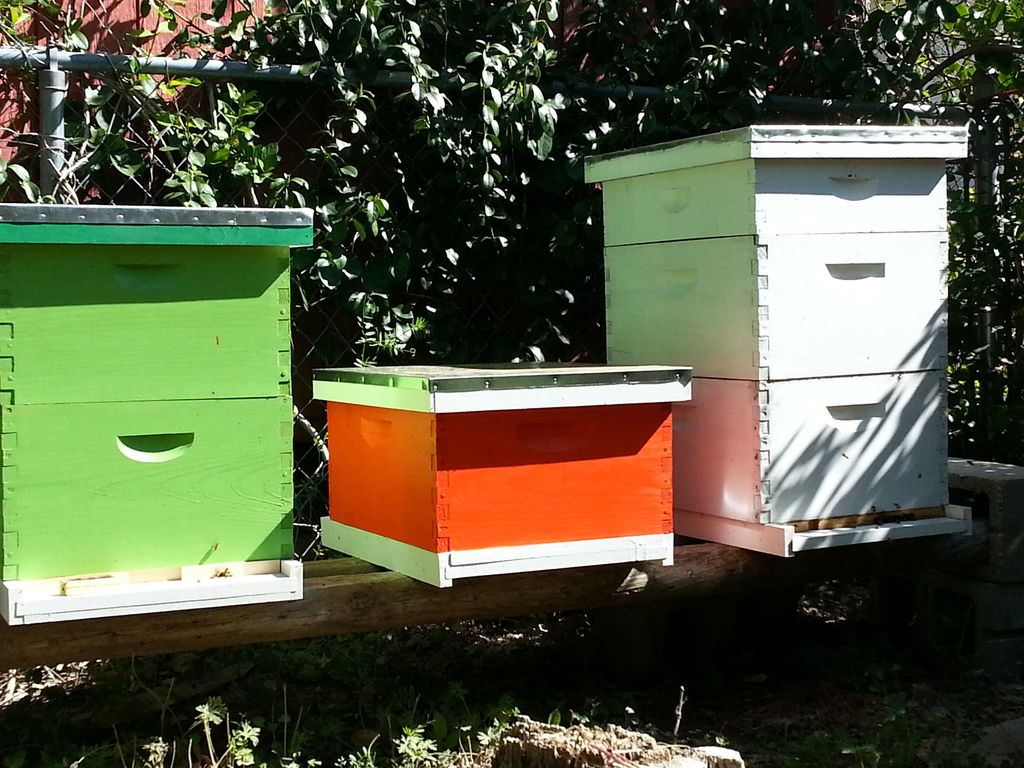
Since I last checked in, all of the equipment I ordered has come in and has been painted.  In the backyard, there are two resource hives, a green one and an orange and blue one.  The orange and blue one will henceforth be known as the Auburn hive (War Eagle!).  There are also three full-sized hives, a light green, a white, and an orange.  I ended up switching a few boxes around just to make the boxes match (green with green, orange with orange, etc).  What can I say?  I'm weird like that.

So, lets get to it, eh?  First, the green nuc (resource hive).  You might remember that this was the hive that got the queen and another frame of brood from the white hive earlier in the year.  They have drawn out the two frames of foundation that they were given.  I saw the queen and an entire frame of eggs/young larvae.  I added the second story with 4 frames of foundation.  If these get drawn and filled before the summer solstice then I'll use them as brood bombs for other hives.  

The Auburn nuc contains the smaller of the two colonies with a new queen.  They have 4 frames of drawn out comb with 4 frames of foundation up top.  Interestingly enough, when I changed out the bottom boards I found what appears to be the bottom of two queen cells, torn open from the side.  The marked queen is still present and the number of bees is not consistent with a hive that has recently swarmed.  Perhaps the queen took out some of her rivals upon being uncaged.  I'm starting to see foragers coming and going from that hive, so it looks like the population is starting to sort itself out.  That's what I love about bees.  They will do what they do and can correct a lot of my mistakes. 

The light green hive, which contains one of the new queens, are starting to draw out foundation in the top box.  There is open brood, so the new queen seems to have been accepted.  Foragers have started flying.  I've still got the entrance reduced to the smallest opening until they build up their population.

I didn't open the white hive today.  They should be very close to being broodless in the next few days, so I think I'll take that opportunity to treat them with oxalic acid vapor.  

The orange hive, which contains the queen from the old green hive (which is really the hive that started the year as a nuc, confused yet?) almost look like they are in early swarm prep mode.  I saw a few queen cups.  They are dry with no eggs, so they could be practice cups, but the hive does look like it's getting a little crowded though.  I opened the broodnest up by giving them some frames that are half empty (deep frames with shallow foundation).  I also gave them a second box of foundation.  A couple of those frames are also half frames (I'm out of deep foundation).   I'll keep an eye on this hive to make sure that they aren't planning to swarm and may open up the broodnest again using these frames depending on what I see.

A few other things to note.  The cinnamon stick thing seems to have worked on the Auburn nuc, so I'm going to try it on the white hive as well since they are being harassed by 
Most concerning, I've noticed bees crawling outside the hive.  It's not exactly the right time of year for tracheal mites and I'm not seeing K-wing.  It's not a concerning number yet.  Usually less than a dozen a day.  If it doesn't clear up after the OAV next week then I'll reassess the situation.

Saturday, April 8, 2017

Coming Together

About half of my equipment came in.  I love it when I come home to find a big box from Mann Lake before the shipping notice has even made it to my email inbox!  I have three deep boxes, plus frames and foundation to go in them.  I'll admit here that putting together frames is probably my very least favorite part of beekeeping.  I can't wait until my kiddo is old enough that I can pay him to do it.  I'm still waiting on the resource hive from Brushy Mt., but I've got what I need for right now.

The queen that was in the queenless half of the green hive has been released.  I didn't find her, but I found 5 sealed queen cells.  I'm not sure if they are trying to supercede her or if they thought they had gone queenless.  I cut them out and I'll check them in a week to see if there is uncapped brood.  If there is then we're all good.  Otherwise I'll give them a frame with eggs on it.  I gave them a second deep of foundation to work with.

The other new queen was uncaged and walking around.  For the record, marked queens are freaking awesome!  I much prefer raising my own queens, but I may have to learn how to mark my queens.  Their population is a little lower than I'd like, so I think the plan of transferring them into the nuc hive when it gets here is the right thing to do.  I'm sure that they will not be pleased about being moved twice in two weeks, but it is what it is.  

I think I'll end up shuffling some of this equipment around when everything gets here.  The colony with the marked queen is going to go into the resource hive when it gets here and the orange box that they are in now will be used as the second deep for the other orange box.


The two hives on the left have new queens and the white hive is raising a queen.


Tuesday, March 28, 2017

Queen cells!

I went back in and checked the now-queenless white hive in the backyard.  You guys, I cut out at least 30 queen cells.  They weren't playing around.  I left them two to raise a new queen with and will check on them in a couple of weeks.

Sunday, March 19, 2017

It's been awhile

Is it just me, or does bee season progress kind of like starting an old Volkswagen?  It takes awhile to really get started with a few sputters along the way, but once it gets going it really gets going.  All that was to say that it feels like it's been forever since I got to play with the girls (and a few guys now too).  Because I now have three hives I think I need a better way to differentiate between them.  For now, we'll just use color.  The hives in the backyard are white and green.  I know a lot of people just use white, but I tend to use whatever color I can find in the old paint section of my husband's tool room.  The white hive in the backyard is the one that came through winter as a full hive and the green hive is the one that started out the season as a nuc.

The white hive is absolutely bursting with bees.  I found 7-8 frames of brood with enough bees to cover them.  They've moved up into the honey super, but haven't started drawing it out.  Disconcertingly, I found several dry queen cups and a few suspicious looking cells in the ladder comb between the two boxes.  I'm not sure if it was a true queen cell or just an awkwardly shaped cell due to being ladder comb.  I was hoping to avoid having to split this hive this year, as I planned for it to be my main production colony.

The green hive is still moving a little slowly.  I saw a few of the ladies doing the waggle dance, so something they like is blooming somewhere.  They had 5 good frames of brood and have started to draw out a few frames in the top box.  

I'm a bit concerned about the outyard hive.  They only have 4 frames of brood and they are small patches.  There doesn't seem to be enough brood to cover much more, so hopefully once there is a hatch out of nurse bees the population will pick up.  If I have to, I can get a new queen in about 2 weeks.  

One thing I did notice is that the SHB seems much lower today then it did just a few weeks ago.  We had a recent cold snap, so maybe that killed some of them off.  One can only dream, right?

Queen, Queen, Who's got a Queen?

I'll start out by apologizing for missing a week.  I did get into the hives last week, but had a closer-than-I'm-comfortable-with br...